The Legendary Warrior Peshwa
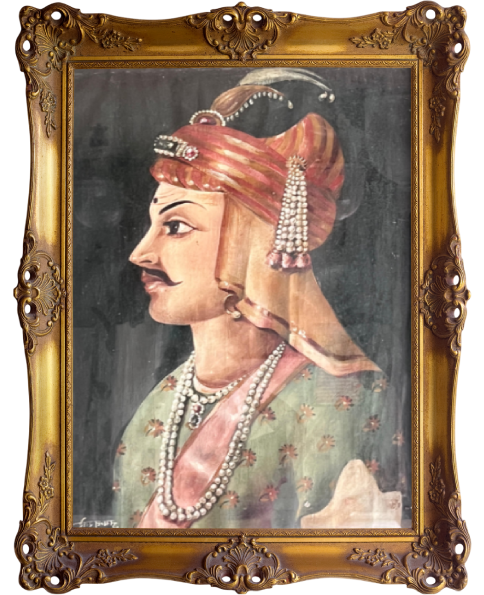
Bajirao 1st, the epitome of bravery, second only to Chhatrapati Shivaji Maharaj.
After the cruel death of Sambhaji Maharaj, the Marathas were fighting with the Moghuls on their own merit.
It was Shambhu Maharaj, son of Sambhaji Maharaj who brought the Marathas under one roof. This unity was achieved by Balaji Vishwanath who was accorded the title of Peshwa.
Balaji was instrumental in procuring the reinstatement of Shambhu Maharaj as the de facto ruler of swarajya through a Farman by the Badshah. The rights of Chauth and Sardeshmukhi were also awarded to the Marathas at the same time. Due to his diplomacy, he was responsible in the release of Yesubai, Shahu’s mother, who was in Mughal custody.
After Balaji’s death, his son, only 19 years of age was appointed as the Peshwa. Shahu’s choice was perfect. Bajirao had the intelligence, perception and maturity which belied his young years.
Bajirao set forth with aplomb, prepared his army and captured, Balaghat, Khandesh, Malwa and Gujrat, attaching it to the Maratha State.
He was successful in the campaign of Chitradurg and Carnatic. In Kanhoji Angre he found an ally and together they achieved bringing back Chauth from Alibag.
Nizam Ul Mulk was a reputed Commander of the Mughal army. He was the Subedar of six districts in the southern region. A man with immense wealth and power, he had a large army and state of the art artillery.
The Nizam was 30 years older than Bajirao and was his contemporary. The Nizam created hurdles when the Maratha armies went to collect their rightful Chauth and sardeshmukhi. With cunning he masterminded the defection of leaders like Chandrasen Jadhav, Sultanji, Rambhaji Nimbalkar, Udaji Chavan, and Kanhoji Bhosle, bringing them to his camp.
This was intolerable and Bajirao decided to teach the Nizam a lesson. He had the full support of Shahu Maharaj.
The Nizam sent Aibat Khan to cause a disturbance and to loot Pune. As soon as Bajirao heard this, he reached the Nizams territories of Sindhakhed and Jalna, looting and ransacking them. The Nizam went after him to capture him. Bajirao’s army were on horse back whilst the Nizams army had canons and artillery and a huge army. His progress was slow. By the time the Nizam reached one region, Bajirao and his army had moved to the next. This went on for quite a few days. Moving from Varhad, Burhanpur, Mahur, Vashim to Khandesh, Bajirao entered Gujrat. The Nizams army followed but were tired. He thought if Pune was attacked Bajirao would seek defeat. This was not to be, for instead of coming back to Pune, Bajirao attacked Aurangabad, the Capital of the Nizam. The Nizam was now scared of loosing his state. He left in a hurry to save his capital. As his army with artillery was cumbersome, he decided to leave the artillery at Ahmednagar. This error of judgement cost him dearly as he lost half of his martial strength.
Following Bajirao, he reached Palked, which was close to Aurangabed, and fell right into the trap laid by Bajirao. The Nizams army was enclosed from all sides.
By the Maratha army. Their food and water were cut off and they found themselves in dire straits. The army was tired hungry and they lost patience. The mighty Nizam admitted defeat without a battle. In 1728 he signed a treaty beneficial to the Marathas. This ‘Strategic Warfare’ without the loss of even a drop of blood is taught in Military Schools all over, even to this day.
The treaty was a milestone in Maratha history, earning Bajirao a prestigious place in the court of Shahu Maharaj.
Thus began the aggressive and diplomatic time of Bajirao. He was fortunate to have his equally brave younger brother, Chimaji Appa and also his close associates and warriors, Ranoji Shinde,Malhar rao Holkar, Udaji Pawar, Naro Shanker, Baji Bhivrao etc with him.
After achieving dominance in the Southern regions, Bajirao left for Bundelkhand to assist Chhatrasaal. At the same time a request for help arrived from Ulkirna Mandloi, who was being harassed by the Mughal Subedar in Malwa. The cost of the campaign would be taken care of by the Mandlois. Bajirao could not be at two places at one time so he sent Chimaji to Malwa. The brave warrior Chimaji Appa and his Maratha army routed the forces of the Moghuls and attached Malwa to Swarajya.
In Bundelkhand, Bajirao defeated Bangash and returning Chhatrasaal’s territory back to him. In gratitude Chhatrasaal gave away his daughter Mastani, born from his Muslim wife, to Bajirao. 1/3rd of his territory including the panna mines were gifted to Bajirao and from then on, Chhatrasaal considered him as his 3rd son.
In the south, the Nizam had not forgotten his defeat. Once again gathering a large army he attacked Bajirao. The battle was fierce and yet again the Nizam was defeated.
The North and South were subjugated but trouble was brewing in the west. In 1534, the Sultan of Gujrat had gifted the fort of Vasai to the Portuguese. The propaganda of spreading Christianity took a foothold, with the formation of the ‘Inquisition’ in Goa. Thence began a period of forced conversions, harassment of the Hindus and slaughter. The Hindu community were helpless against this onslaught. In 1567, 280 Hindu temples were demolished.
Bajirao turned his attention to the plight of the Hindus which had gone on for a couple of centuries. There was a lot of communication to him from Vasai regarding the deteriorating situation. In 1739, Chimaji Appa was sent to Vasai with an army. The fort of Vasai was strong and the Maratha army laid a siege which lasted for two years and almost two months. Chimaji Appa vanquished the Portuguese and captured the fort. It had been with them for 200 years.
Later the Portuguese were stopped at Goa, Vasai, Thana, Kalwa Mahim etc. Protection was provided to the Hindus at Vasai and Goa.
Bajirao had decided Pune to be his administrative capital. In 1730 he laid the foundation stone for Shaniwarwada in Shaniwar Peth. The wada was completed in 1732. As the family increased, more establishments were added to the enclosure.
Bajirao gave his heart and soul the make the Maratha Confederacy a strong force. He did not tolerate traitors and dealt with them severely. He trained the army to such an extent that new fearless soldiers were born from the Maratha region.
The Marathas slowly increased their territory by defeating the Mughals. There was once again a modicum of peace in the region with people moving about without fear.
Shaniwarwada became the hub of the administration of Hindustan.
Bajirao’s war strategy that of speed and catching the enemy unawares. The enemy never knew when and from where they would be attacked until it was too late.
It was important for the northern regions to remain with, and be administered by the Marathas. He gave powers to Shinde, Holkar, Jadhav, Gaikwad and Pawar, to administer them. Next making sure the regions were in safe hands he turned his attention to Janjira, teaching Siddi a lesson.
In 1735 he reached Delhi. Wit a small army he reached near Udaipur. Here, he met Yadgaar Khan who was sent by the Badshah from Delhi. Once he got the confirmation of certain demands, he went back.
In 1737, he yet again reached near Delhi and defeated Sadatkhan in such a way that his ego was completely deflated. After showing Sadatkhan his place he left for Pune.
The Ruler of Iran, Nadir Shah invaded Delhi. The Badshah pleaded with Bajirao to help quell this invasion. Bajirao started for Delhi immediately but before he could reach, Nadirshah had looted Delhi, massacred the subjects and left.
The undefeated warrior Bajirao lost his last battle, that of his life, on the banks of the Narmada at Raver. He was unwell after the nonstop travel from Varkhed to Raver where he had set up camp. Ignoring the advice of Malharrao, Pilaji and Ranba he went swimming in the Narmada. While he suffered from a fever he swam the next day too. On that day the scorching sun was merciless and so was his body temperature. The fever grew worse. The vaids and hakims tried their best but were not successful.
He breathed his last on 28th April 1740 (Vaishakh Shudh, 13 Shake’ 1662). He was cremated on the banks of the Narmada. A Memorial stands in his honour at Raver Khedi where he had built his camp.
In his short span he was instrumental in increasing the Maratha Empire and bring back the glory of the Marathas.